Why PET widely used the Beverage Industry
PET (Polyethylene Terephthalate) has become the most widely used packaging material in the global beverage industry. Its combination of lightweight construction, shatter resistance, recyclability, and cost efficiency has made it the default choice for water, soft drinks, juices, and increasingly for beer, wine, and dairy products.
The global PET bottle market continues to expand, driven by population growth, urbanisation, and the shift from glass and metal packaging in emerging markets. For producers entering new markets or expanding capacity, used PET filling lines offer a cost-effective alternative to new equipment, often at 40-60% of the original investment.
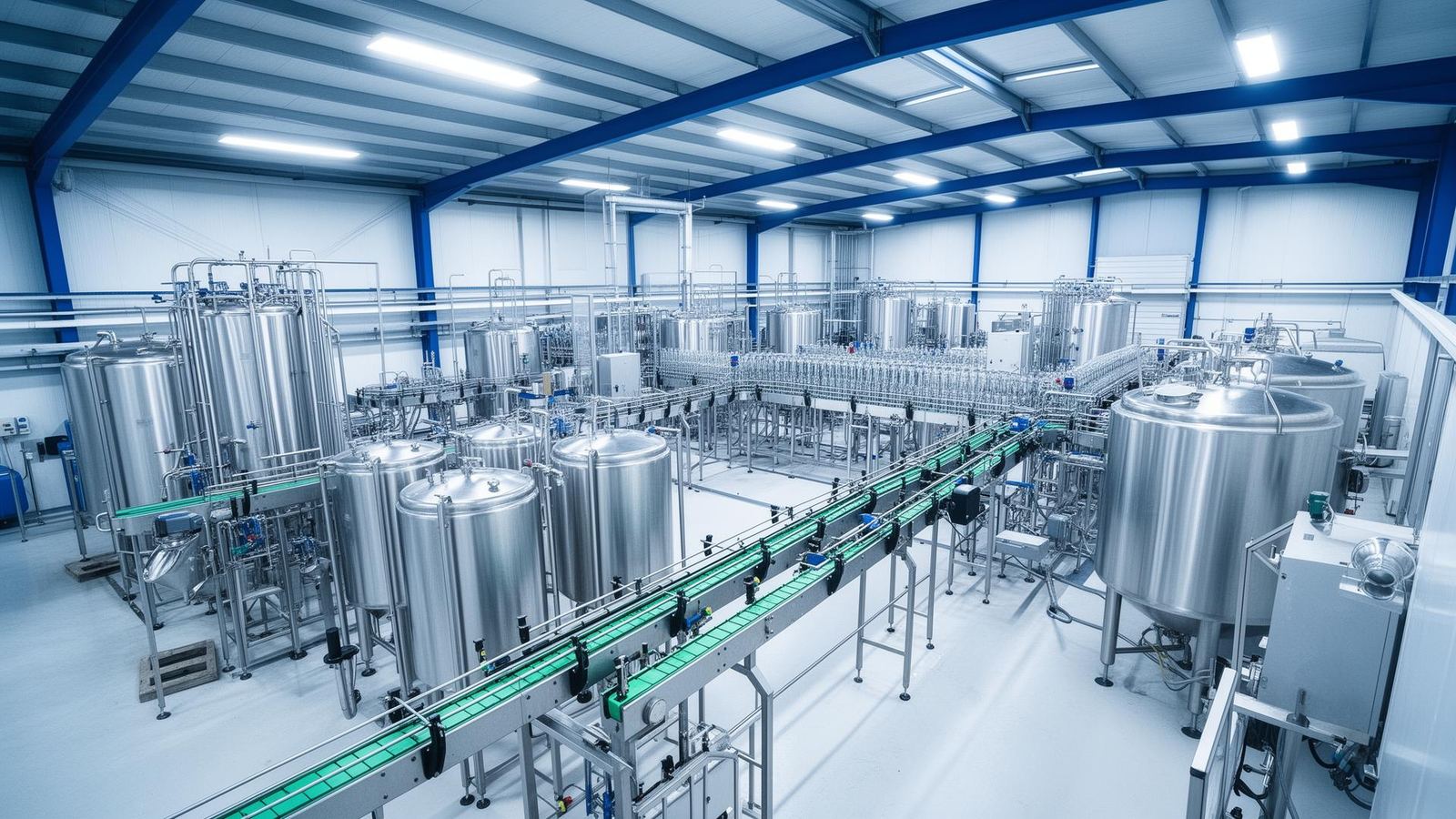
A complete PET filling line typically includes: preform storage and feeding, blow moulding (stretch blow moulding), air conveying, rinsing, filling, capping, labelling (sleeve or adhesive), date coding, shrink wrapping or case packing, and palletising. Each section must be evaluated independently when purchasing used equipment.
Key Components of a Used PET Filling Line
Blow Moulding Machines: The heart of any PET line. Rotary stretch blow moulders from manufacturers like Sidel (SBO series), KHS (InnoPET Blomax), Krones (Contiform), and SIPA handle high-speed production from 6,000 to 80,000+ bottles per hour. When evaluating used blow moulders, inspect oven lamp condition, mould wear, stretching rod alignment, and compressed air system efficiency.
Rinsers and Fillers: PET fillers operate primarily with isobaric (counter-pressure) technology for carbonated beverages or gravity/flow-meter technology for still products. Key manufacturers include Krones (Modulfill, Volumetic), KHS (Innofill), Sidel (Eurotronica), and GEA. Inspect valve seats, flowmeters, CIP connections, and filling accuracy across all heads.
Cappers: Screw cappers are standard for PET applications. Check torque consistency, chuck wear, and cap feeding systems. Arol, Zalkin, and Krones Checkmat are common brands in the used market.
Labellers: Depending on the product, PET lines may use roll-fed (OPP), self-adhesive, or sleeve labelling. Krones, Sidel, P.E. Labellers, and Sacmi are established manufacturers. Evaluate label positioning accuracy and changeover flexibility.
Evaluating Line Speed and Integration
One of the most critical factors when purchasing a used PET filling line is ensuring all components are speed-matched. A common mistake is acquiring a high-speed filler without verifying that upstream and downstream equipment can sustain the same throughput.
For example, a 24,000 BPH filler requires a blow moulder capable of at least 26,000-28,000 BPH to account for efficiency losses. Similarly, the labeller, packer, and palletiser must handle the output speed with adequate buffer capacity.
Conveyor integration is equally important. PET bottles are typically transported by air conveyors from the blow moulder to the filler, then by slat-band or mat-top conveyors through downstream equipment. Check conveyor condition, guide rail adjustability, and accumulation table capacity.
Control system compatibility must be verified. Older lines may run on Siemens S5 or S7-300 PLCs, while newer equipment uses S7-1500 or Allen-Bradley platforms. Ensure spare parts availability and the possibility of software updates or migration.
Always request production reports showing actual OEE (Overall Equipment Effectiveness) data rather than theoretical speeds.
PET Line Configurations by Product Type
Still Water: The simplest PET filling application. Gravity or electronic volumetric fillers operating at ambient temperature. Lines can achieve the highest speeds (up to 80,000 BPH on large rotary systems). Hot-fill is used for certain flavoured water products.
Carbonated Soft Drinks (CSD): Require isobaric (counter-pressure) filling to maintain CO2 levels. Pre-cooling and deaeration systems are essential. Counter-pressure fillers from Krones, KHS, and Sidel are the standard. CSD lines also require more robust capping to prevent gas loss.
Juice and Isotonic: Often filled using hot-fill technology (85-90°C) or aseptic filling. Hot-fill PET requires specially designed bottles with vacuum panels. Aseptic PET filling (e.g., Sidel Aseptic Combi) represents the premium end of the used market.
Beer in PET: Growing segment in Eastern Europe and emerging markets. Requires multi-layer PET bottles with oxygen barriers, counter-pressure filling, and often nitrogen dosing. Specialised equipment from KHS and Krones is available in the used market.
Oil and Liquid Foods: Volumetric or mass-flow filling technology. Higher viscosity products require positive displacement pumps and specialised valve configurations.
Cost Considerations and Market Availability
The used PET filling line market is one of the most active segments in the secondary equipment sector. Lines become available when producers upgrade capacity, change product formats, or consolidate production facilities.
Price ranges for used PET lines vary significantly based on speed, age, condition, and manufacturer:
- Entry-level lines (4,000-8,000 BPH): €150,000-€400,000
- Mid-range lines (12,000-24,000 BPH): €400,000-€1,200,000
- High-speed lines (36,000-60,000 BPH): €1,000,000-€3,000,000+
Additional costs to budget include: dismantling and transport (€30,000-€100,000 depending on distance), installation and commissioning (€50,000-€150,000), spare parts inventory, and potential refurbishment of wear components.
Working with a specialised dealer like BottlingScout gives access to equipment listed with technical specifications, photos and stated condition.
Frequently asked questions
What speed should I look for in a used PET filling line?
Speed depends on your production requirements. For small to medium producers, 6,000-12,000 BPH is typical. Medium operations target 18,000-36,000 BPH. Large-scale producers look for 40,000+ BPH. Always match blow moulder capacity to filler speed with a 10-15% buffer.
Can a used PET line be converted from one product to another?
Yes, many PET lines can be adapted. Converting from still water to CSD requires replacing the filler with an isobaric model and adding carbonation equipment. Bottle format changes require new blow moulds and conveyor adjustments. Label changes are usually the simplest modification.
What is the typical lifespan of a PET filling line?
Well-maintained PET filling lines can operate for 15-25 years. Key wear components (blow moulder lamps, filler valves, labeller components) require periodic replacement, but the mechanical structure and main drives have very long service lives. Lines from established manufacturers like Krones, Sidel, and KHS retain value particularly well.
How long does it take to install a used PET filling line?
Installation typically takes 4-8 weeks depending on line complexity, site preparation requirements, and whether utilities (compressed air, water, electricity) are already available. Commissioning and operator training add another 1-2 weeks.