
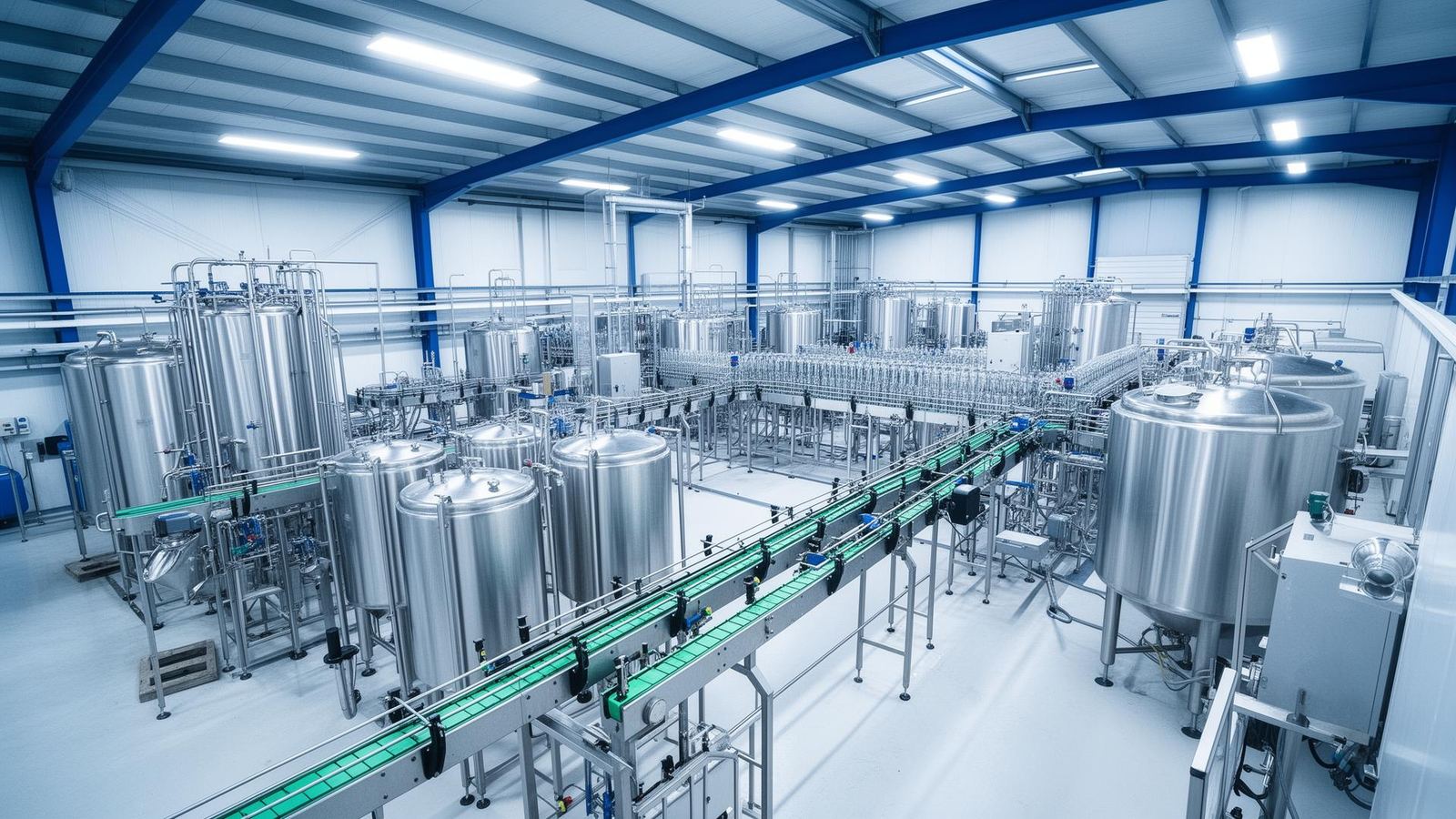
Beverage Preparation Before Filling
Premix systems and saturators are upstream processing equipment that prepare the beverage before it reaches the filler. Premix units blend water, syrup, and other ingredients to create the final beverage, while saturators dissolve CO₂ to create carbonated drinks. These systems directly impact product quality and consistency. Used preparation equipment from established manufacturers provides documented performance when properly evaluated.
Premix Systems
Premix (or proportional blending) systems continuously blend water and concentrated syrup at precise ratios. Key components include:
- Deaeration unit — removes dissolved oxygen from water before blending
- Syrup room — stores and supplies concentrated syrup to the blender
- Proportional blender — mixes water and syrup at the specified Brix ratio
- Inline instruments — Brix meters, flow meters, and density sensors for quality control
- Pasteuriser integration — some systems include inline flash pasteurisation
Saturators (Carbonators)
Saturators dissolve carbon dioxide into the blended beverage at controlled temperature and pressure:
- Spray-type saturators — spray product through CO₂ atmosphere for rapid absorption
- Inline carbonators — inject CO₂ into the product stream using static mixers
- Tank saturators — carbonate product in a pressurised vessel
- CO₂ recovery systems — capture and recycle CO₂ from fermentation (brewery applications)
Critical Inspection Points
- Blending accuracy — verify Brix ratio consistency at production speed
- CO₂ volumes achieved — measure actual carbonation level vs specification
- Deaeration efficiency — dissolved oxygen levels directly affect product shelf life
- Product-contact surfaces — stainless steel condition and surface finish for food safety
- Control system — verify recipe management, data logging, and cleaning programme capability
- CIP integration — the entire preparation system must be cleanable in place
Common Issues
Problems to Watch For
- Blending ratio drift causing inconsistent product flavour — often due to worn flow meters
- Saturator inefficiency from worn spray nozzles or internal corrosion
- Deaerator vacuum pump degradation reducing oxygen removal effectiveness
- Outdated control systems lacking modern recipe management and data logging
- Product-contact surface degradation from years of CIP chemical exposure
Frequently asked questions
Do I need a premix system for water bottling?
Still water bottling typically does not require a premix system — water treatment and filtration feed the filler directly. Sparkling water production requires a saturator for CO₂ injection. Flavoured water products may need a simple blending system.
What CO₂ volume levels are standard?
CO₂ volumes vary by product: sparkling water typically requires 3.5-5.0 volumes, cola products 3.5-4.0 volumes, beer 2.2-2.8 volumes, and lightly carbonated beverages 1.5-2.5 volumes. The saturator must achieve your target level consistently.
Can used premix equipment handle different product recipes?
Modern premix systems with recipe-based controls can handle multiple product formulations. Older systems with manual ratio adjustment may be limited. Verify the control system capability matches your product range requirements.